

Understanding Car Speaker Efficiency and Sound Performance
When choosing a car speaker, many people focus on specifications like:
- Power rating (Watts)
- RMS power
- Speaker size
- Magnet size
However, there is another important specification that is often overlooked:
Speaker sensitivity.
Speaker sensitivity affects how efficiently a speaker converts electrical power into sound output.
A speaker with higher sensitivity can produce louder sound with less amplifier power, while a lower sensitivity speaker may require more power to achieve the same output level.
Understanding sensitivity helps you choose the right car speaker and build a better car audio system.
What Is Speaker Sensitivity?
Speaker sensitivity measures how efficiently a speaker converts electrical energy into sound.
It is usually measured in:
dB (decibels)
A typical sensitivity specification may look like:
- 88dB
- 92dB
- 95dB
- 98dB
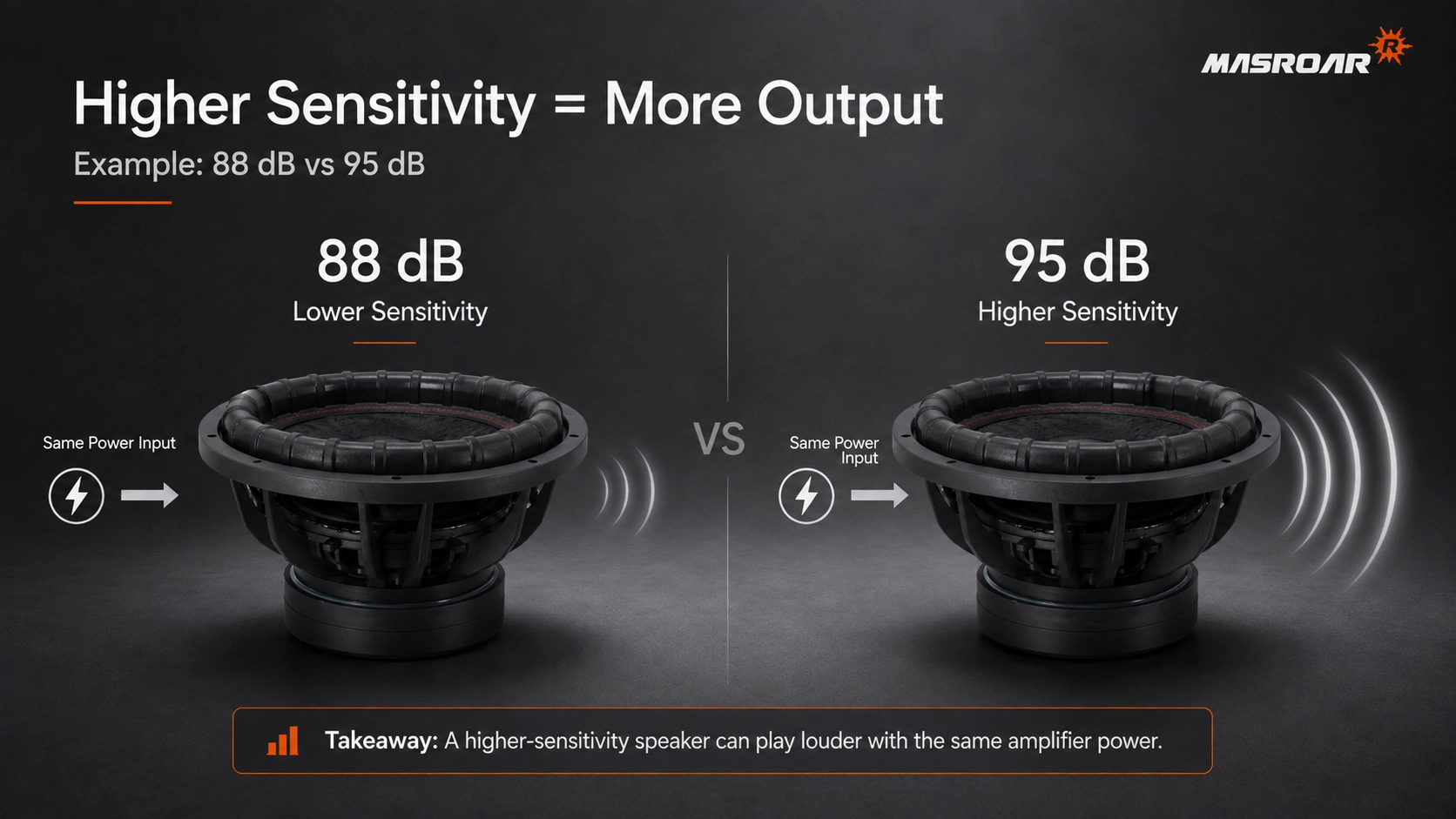
The higher the sensitivity value, the more sound output the speaker can produce from the same amount of power.
For example:
A 95dB speaker will generally produce more output than an 88dB speaker when both receive the same amplifier power.
Why Does Speaker Sensitivity Matter?
Sensitivity is important because it affects the relationship between the speaker and amplifier.
A high-sensitivity car speaker can provide:
- Higher output with less power
- Better efficiency
- Easier amplifier matching
This is especially useful for systems where amplifier power is limited.
For example:
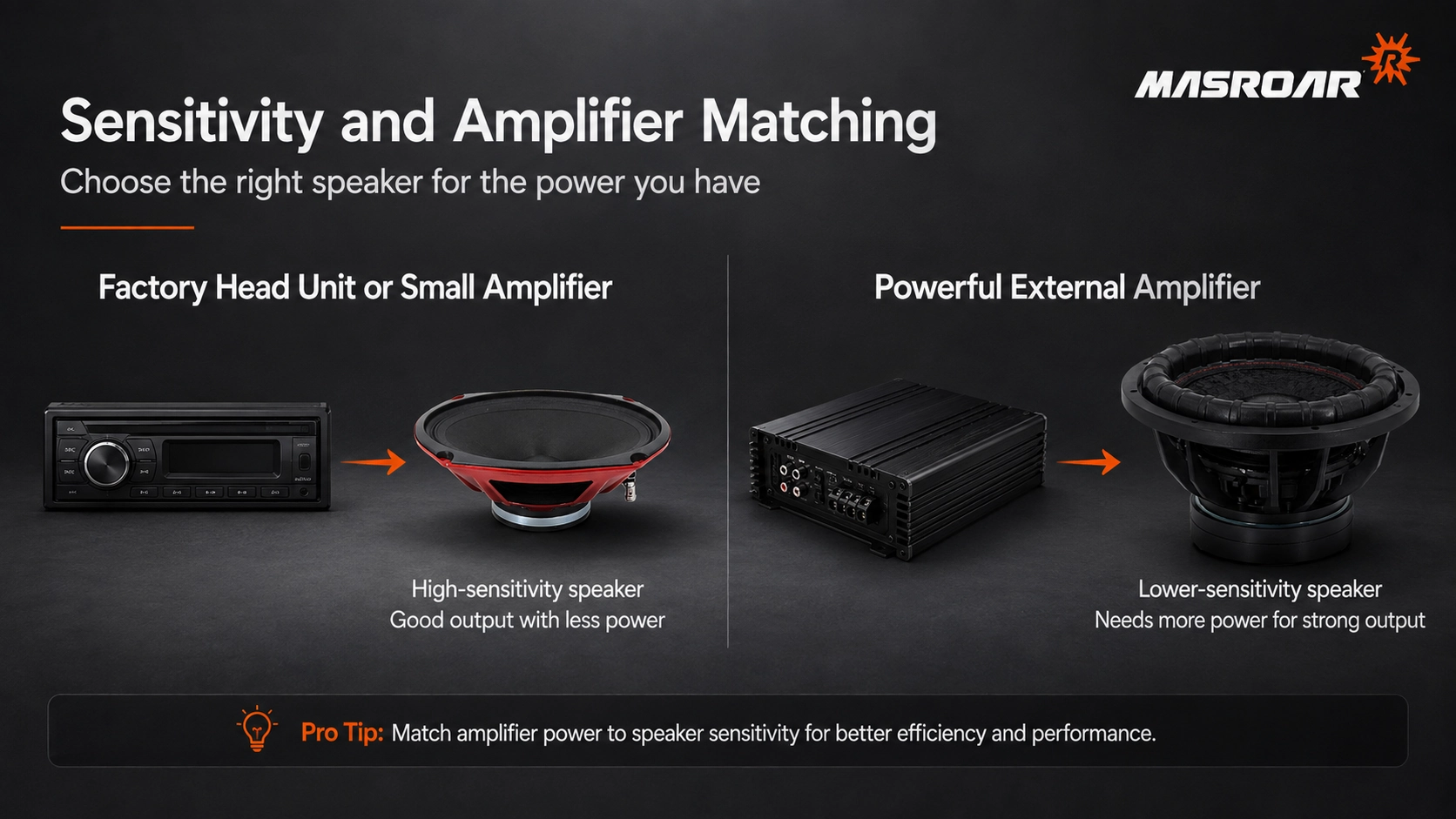
A factory car audio system usually has limited amplifier power. A high-sensitivity speaker can deliver better performance without requiring a powerful external amplifier.
Sensitivity vs Power: Which One Is More Important?
Many people think:
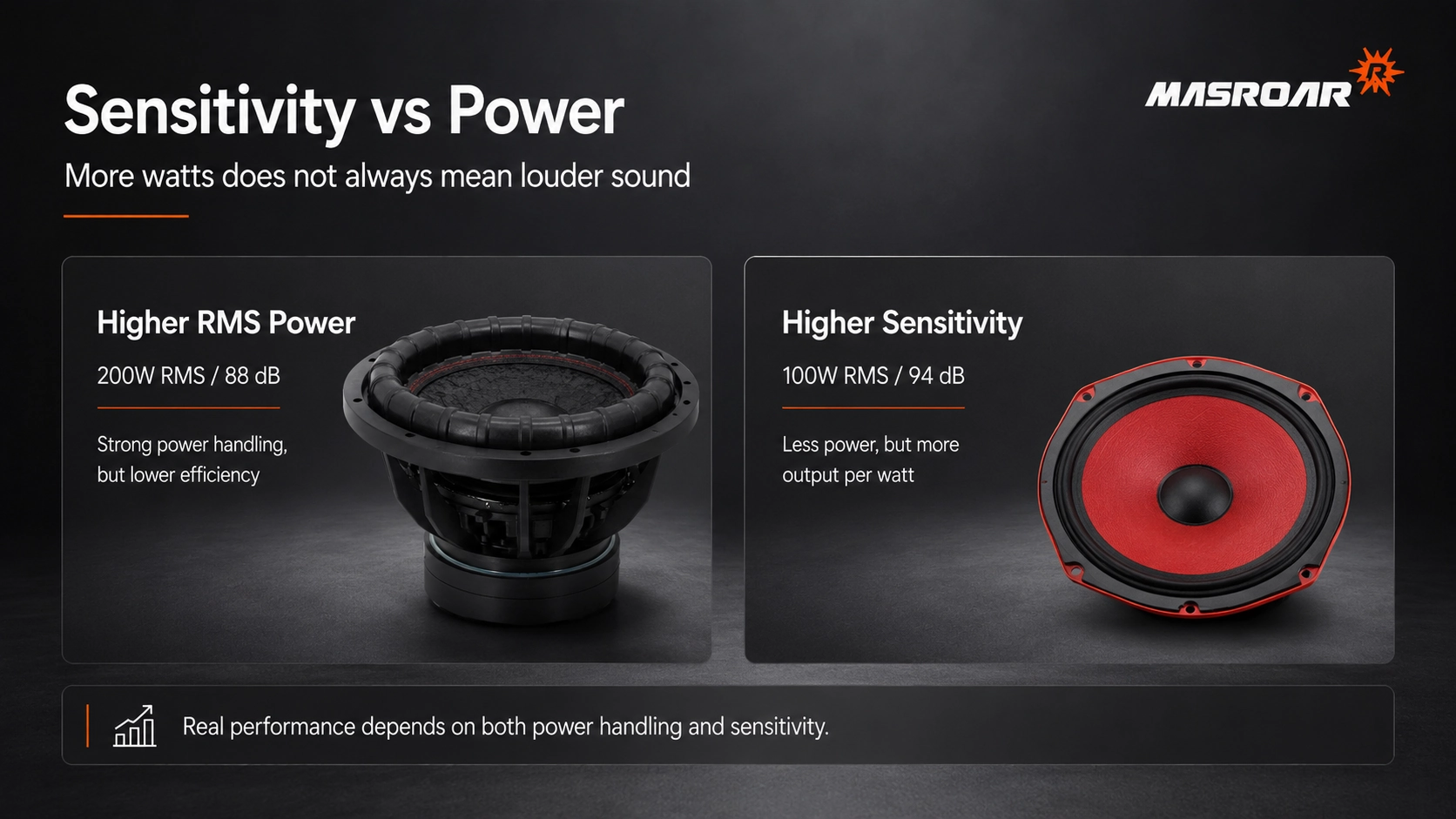
More watts always means louder sound.
But this is not always true.
Real speaker performance depends on several factors:
- RMS power handling
- Sensitivity
- Frequency response
- Speaker design
- Installation quality
A speaker with higher RMS power capability is not necessarily louder if its sensitivity is lower.
A well-designed car speaker system balances power and efficiency.
High Sensitivity Car Speakers
High sensitivity speakers are designed to produce strong output with less amplifier power.
They are commonly suitable for:
- Factory audio upgrades
- Daily driving systems
- Efficient car audio setups
Advantages include:
- Easier Amplifier Matching
They can achieve good volume levels without requiring extremely powerful amplifiers.
- Better Efficiency
Less electrical power is wasted as heat, allowing more energy to be converted into sound.
- Strong Output Performance
High sensitivity speakers can deliver clear and powerful sound even in moderate-power systems.
Low Sensitivity Car Speakers
Lower sensitivity speakers are not necessarily worse.
They are often designed for systems with stronger amplification.
They may be suitable for:
- High-power car audio systems
- Competition systems
- Professional installations
These systems usually use more powerful amplifiers to achieve the required output.
The advantage is that they can still deliver excellent sound when properly matched.
How Sensitivity Works With Different Car Speakers
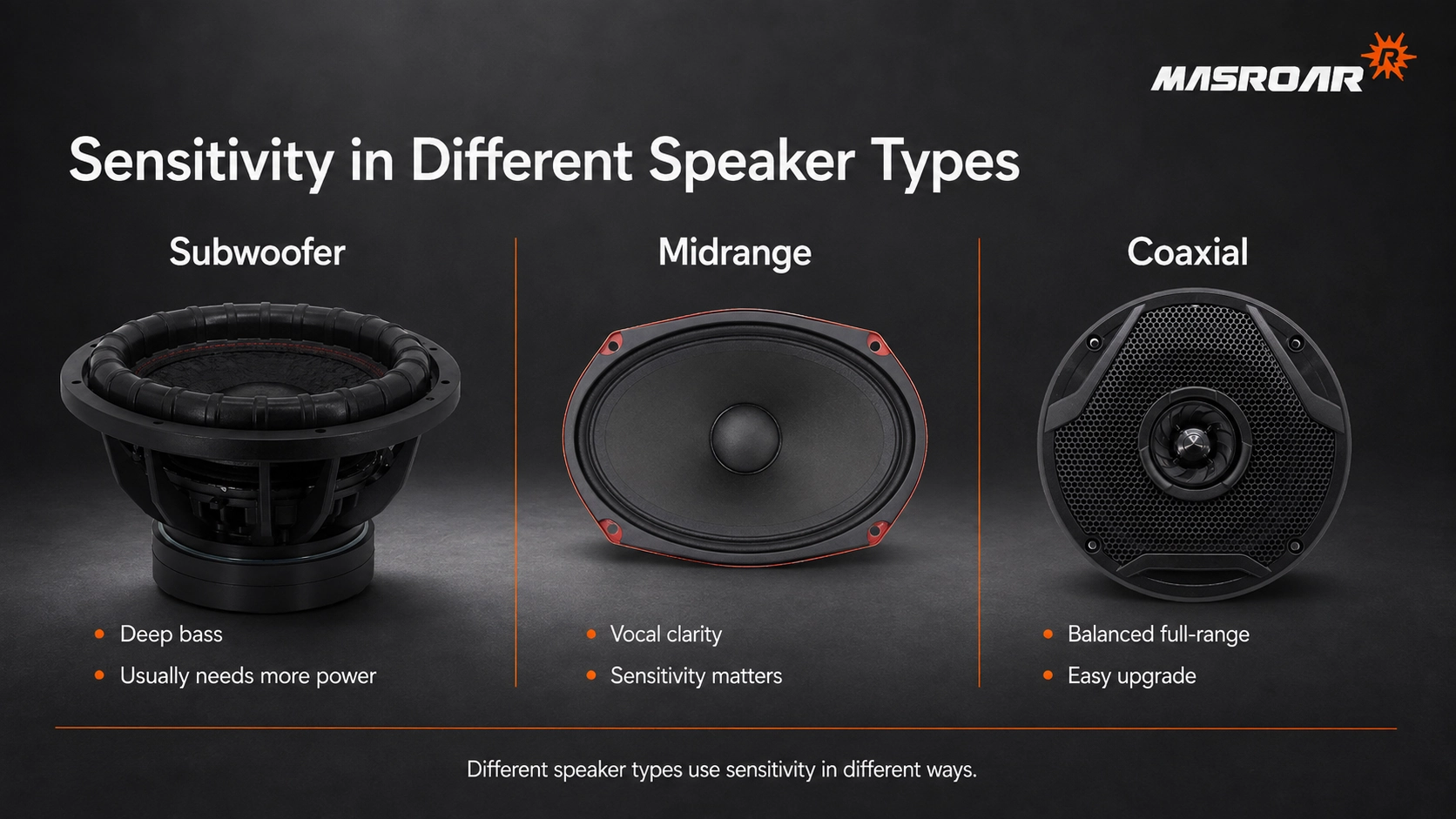
Different speaker types have different priorities.
Car Subwoofer
For a car subwoofer, important factors include:
- Power handling
- Cone movement
- Low-frequency performance
- Efficiency
Subwoofers often require more power because producing deep bass requires moving large amounts of air.
Midrange Speaker
For a midrange speaker, sensitivity is especially important.
Higher sensitivity helps improve:
- Vocal clarity
- Sound presence
- Output efficiency
This is why many professional systems pay close attention to midrange sensitivity.
Coaxial Speaker
For a coaxial speaker, the goal is balance.
Important factors include:
- Sensitivity
- Frequency response
- Full-range performance
A good coaxial speaker should provide clear sound without requiring complex installation.
How to Choose the Right Speaker Sensitivity?
There is no single “best” sensitivity level.
The right choice depends on your system.
Daily Driving System
For normal vehicles:
- Moderate to high sensitivity speakers are usually easier to use
- They work well with factory or small amplifiers
High-Power Audio System
For systems using powerful amplifiers:
- Sensitivity becomes one part of the overall design
- Power handling and tuning become equally important
Professional Car Audio Applications
Professional systems usually consider:
- Sensitivity
- RMS power
- Frequency response
- Thermal performance
Together, these specifications determine real performance.
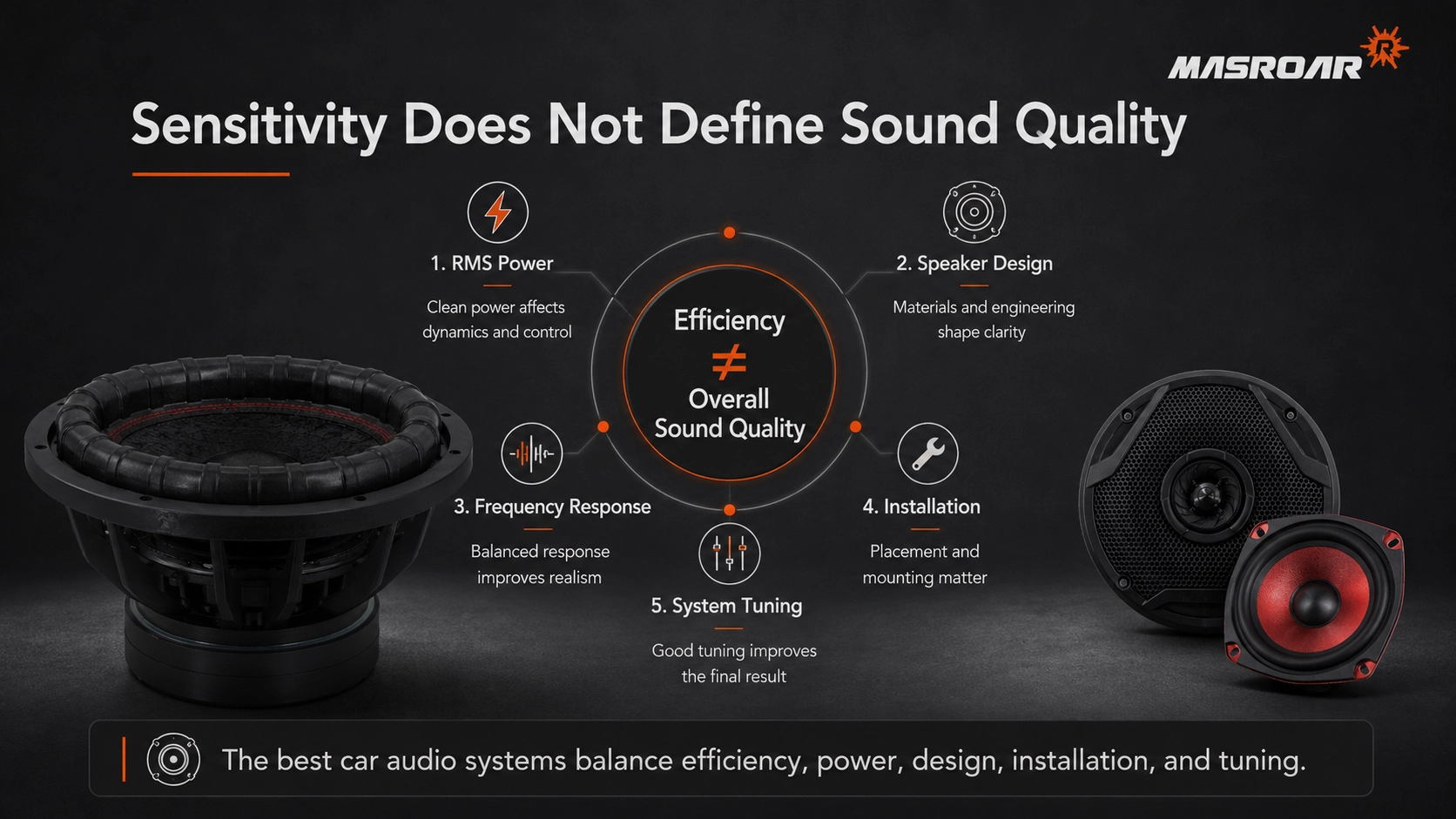
Sensitivity Does Not Define Sound Quality Alone
A common misunderstanding is:
Higher sensitivity always means better sound.
This is incorrect.
Sensitivity only describes efficiency.
Sound quality also depends on:
- Cone material
- Voice coil design
- Magnet system
- Suspension structure
- Acoustic tuning
A well-engineered lower sensitivity speaker can still outperform a poorly designed high sensitivity speaker.
How MR Audio Considers Speaker Sensitivity
At MR Audio, speaker performance is not judged by one specification alone.
We consider:
- Sensitivity
- RMS power handling
- Frequency response
- Mechanical design
- Application requirements
Different vehicles and audio systems require different solutions.
A balanced design helps create reliable performance in real-world driving conditions.
Frequently Asked Questions About Speaker Sensitivity
What does speaker sensitivity mean?
Speaker sensitivity shows how efficiently a speaker converts electrical power into sound output. It is usually measured in decibels (dB).
Is a higher sensitivity speaker better?
Not always. Higher sensitivity means higher efficiency, but overall performance also depends on power handling, design, materials, and tuning.
Are high sensitivity speakers louder?
When using the same amplifier power, a higher sensitivity speaker can usually produce higher sound output.
Does sensitivity affect amplifier choice?
Yes. High sensitivity speakers usually require less amplifier power, while lower sensitivity speakers may need stronger amplification.
What is a good sensitivity rating for car speakers?
The ideal sensitivity depends on the application. Many car speakers fall around 88–95dB, while high-output professional speakers may have higher sensitivity ratings.
Final Thoughts
Speaker sensitivity is an important specification when choosing a car speaker, but it is only one part of the complete system.
A great car audio system requires the right balance between:
- Sensitivity
- Power handling
- Speaker design
- Amplifier matching
- Installation
Understanding sensitivity helps you make better decisions and build a system that performs efficiently.
Because great sound is not only about power.
It is about using power effectively.
Make It Roar.