

A Simple Guide to Understanding Frequency Range in Car Audio
When comparing car speakers, you may see specifications such as:
- 50 Hz–5 kHz
- 80 Hz–10 kHz
- 20 Hz–20 kHz
But what do these numbers actually mean?
Car speaker frequency response describes the range of sound frequencies a speaker is designed to reproduce, usually measured in hertz (Hz). Lower frequencies represent bass, middle frequencies contain much of the vocals and instruments, and higher frequencies provide detail and brightness.
Different types of car speakers are designed for different parts of the frequency range. A good car audio system does not require every speaker to reproduce every frequency.
Instead, subwoofers, midrange speakers, tweeters, and other speaker types work together to create balanced sound.
What Is Frequency Response in a Car Speaker?
Frequency response describes the range of frequencies a speaker can reproduce.
Frequency is measured in hertz (Hz).
In simple terms:
- Lower Hz = deeper bass
- Middle Hz = vocals and instruments
- Higher Hz = treble and fine detail
Humans are generally considered capable of hearing frequencies from approximately 20 Hz to 20,000 Hz, although the actual hearing range varies from person to person.
A single car speaker does not need to reproduce this entire range.
That is why a car audio system may use different types of speakers to handle different parts of the sound spectrum.
Understanding the Main Car Audio Frequency Ranges
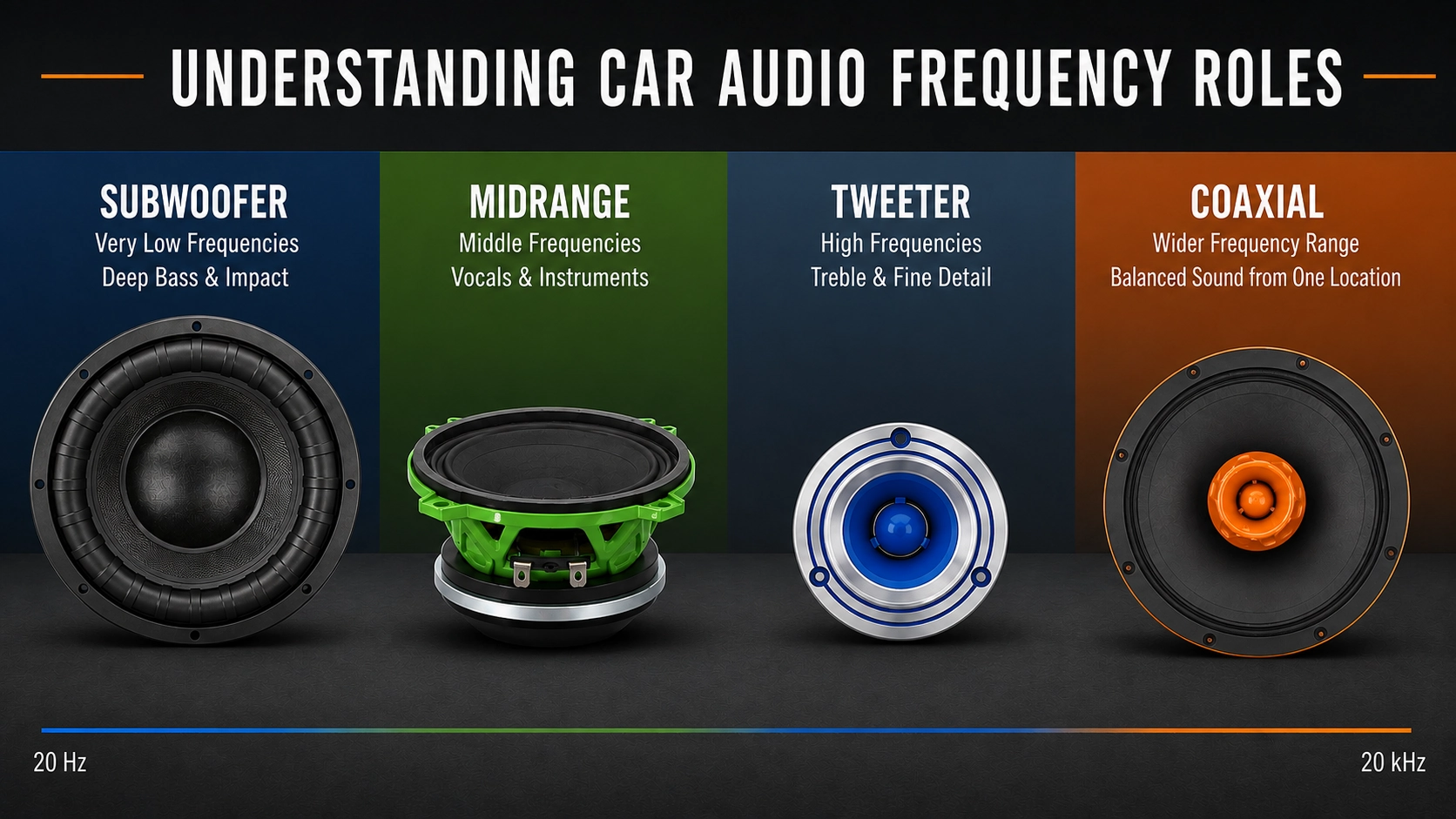
A simple way to understand a car audio system is to look at the role of each speaker.
| Speaker Type | Typical Frequency Role | Main Purpose |
| Subwoofer | Very low frequencies | Deep bass and low-frequency impact |
| Midrange Speaker | Middle frequencies | Vocals and instruments |
| Tweeter | High frequencies | Treble and fine detail |
| Coaxial Speaker | Wider frequency range | Balanced sound from one speaker location |
The exact frequency range varies between products.
Actual operating ranges also depend on:
- Speaker design
- Crossover settings
- Installation
- Amplifier
- System tuning
For this reason, the frequency response listed on a speaker specification sheet should always be considered together with its intended application.
- Subwoofer: Deep Bass
A car subwoofer is designed to reproduce the lowest frequencies in a car audio system.
Depending on the product and system design, a subwoofer commonly focuses on frequencies below approximately 80–100 Hz.
Subwoofers reproduce sounds such as:
- Deep bass notes
- Electronic bass
- Low-frequency drum energy
- Bass-heavy musical effects
This is the frequency area that gives music its depth, weight, and physical impact.
Because reproducing very low frequencies requires moving a large amount of air, subwoofers usually use relatively large cones and require suitable amplifier power.
- Midrange Speaker: Vocals and Musical Energy
A midrange speaker focuses on the middle part of the audio spectrum.
This area contains a large amount of the information we recognize most easily in music, including:
- Human voices
- Guitar
- Piano
- Drums
- Many other musical instruments
The exact frequency range depends heavily on the speaker design.
Some midrange speakers are designed to extend relatively low, while others focus more strongly on the central vocal range.
Good midrange performance helps music sound:
- Clear
- Present
- Powerful
- Natural
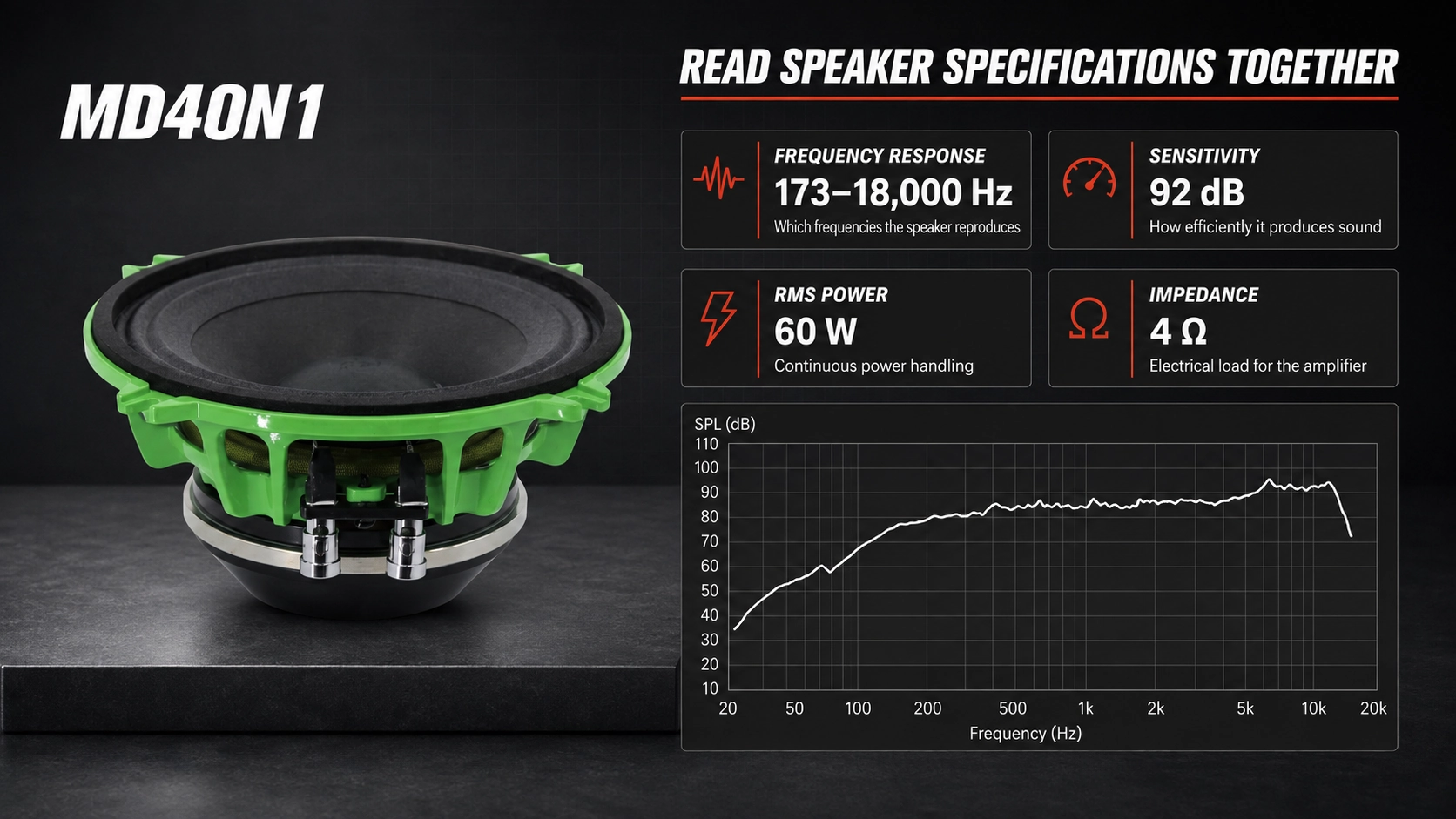
In high-output car audio systems, sensitivity is also an important specification for midrange speakers because it affects how efficiently they produce sound.
- Tweeter: High-Frequency Detail
A tweeter reproduces the upper frequencies of the audio spectrum.
Depending on the design and crossover settings, tweeters normally handle the high-frequency information that larger speakers are not optimized to reproduce.
Tweeters reproduce details such as:
- Cymbals
- High-frequency instrument harmonics
- Vocal details
- Air and brightness in music
A good tweeter should provide clear detail without making the system sound excessively sharp or harsh.
- What About Coaxial Car Speakers?
A coaxial car speaker combines multiple speaker elements into one unit.
For example, a common coaxial design places a tweeter in front of a larger cone.
This allows one speaker location to reproduce a wider range of frequencies.
Coaxial speakers are popular for:
- Factory speaker replacement
- Simple car audio upgrades
- Systems with limited installation space
- Everyday listening
However, a wider frequency range does not automatically mean better performance.
Dedicated subwoofers, midrange speakers, and tweeters can provide more specialized performance when used in a properly designed system.
Why Do Car Speaker Frequency Ranges Overlap?
The frequency ranges of different speakers are not always completely separate.
This is normal.
For example, the upper operating range of one speaker may overlap with the lower operating range of another.
This overlap helps create a smoother transition between speakers.
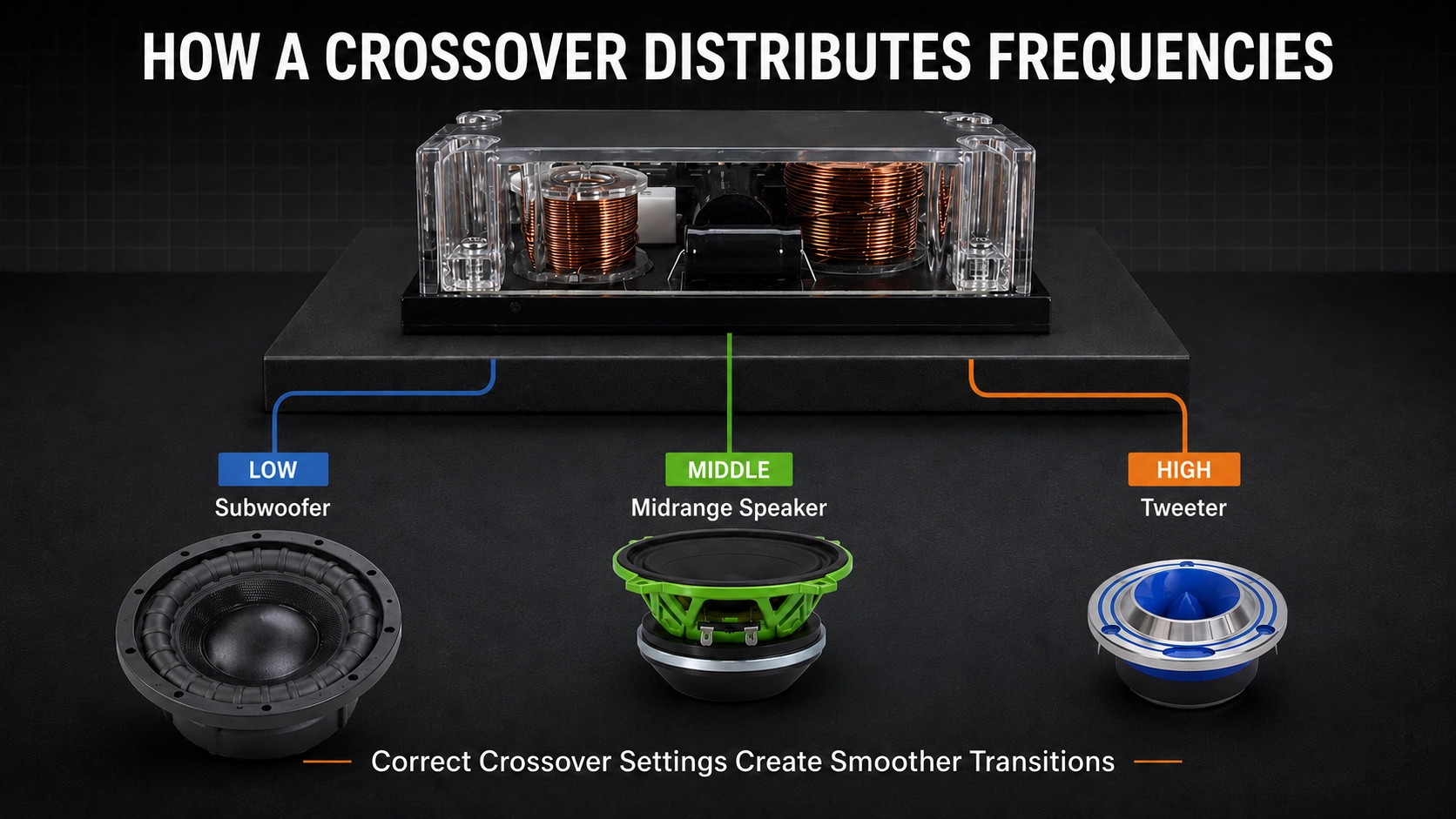
The transition is usually managed by a crossover.
A crossover directs different frequencies to the speakers designed to reproduce them.
A simplified example is:
Low frequencies → Subwoofer
Middle frequencies → Midrange Speaker
High frequencies → Tweeter
The exact crossover points depend on the speakers and the complete system design.
There is no single crossover frequency that is correct for every car audio system.
Does a Wider Frequency Range Mean a Better Car Speaker?
Not necessarily.
A speaker advertised with a very wide frequency range is not automatically better than one with a narrower range.
For example, a dedicated midrange speaker may have a narrower frequency response than a coaxial speaker.
That does not make the midrange speaker worse.
It simply has a different job.
A dedicated midrange speaker may be optimized for:
- Vocal clarity
- High sensitivity
- Strong output
- Controlled performance within its intended frequency range
Therefore, the better question is not:
“Which speaker covers the widest frequency range?”
It is:
“How well does this speaker perform within the frequency range it is designed for?”
Frequency Response vs Sensitivity
Frequency response and sensitivity describe two different aspects of speaker performance.
Frequency response tells you:
What range of frequencies is the speaker designed to reproduce?
Sensitivity tells you:
How efficiently does the speaker convert input power into sound output?
For example, two midrange speakers may cover similar frequency ranges but have different sensitivity ratings.
They can therefore produce different output levels when given the same amplifier power.
This is why professional system design considers both specifications together.
Frequency Response vs RMS Power
Frequency response should also not be confused with RMS power handling.
RMS power describes how much continuous power the speaker is designed to handle.
Frequency response describes the range of sound frequencies the speaker is designed to reproduce.
They answer two completely different questions:
RMS Power → How much continuous power can it handle?
Frequency Response → What frequencies can it reproduce?
When comparing car speakers, buyers should consider:
- Frequency response
- Sensitivity
- RMS power handling
- Impedance
- Speaker design
- Intended application
No single specification tells the complete story.
How Do Different Car Speakers Work Together?
A balanced car audio system divides different parts of the frequency spectrum between suitable speakers.
A simplified system may use:
Subwoofer → Deep bass
Midrange → Vocals and instruments
Tweeter → High-frequency detail
A coaxial speaker can also cover a wider range when a simpler installation is preferred.
The goal is not to make every speaker reproduce every frequency.
The goal is to let each speaker operate effectively within the range it was designed to handle.
When crossover settings, amplifier power, speaker placement, and tuning work together, the different speakers can sound like one complete system.
What Frequency Range Is Best for Car Speakers?
There is no single frequency range that is best for every car speaker.
The correct range depends on the speaker’s purpose.
For example:
- A subwoofer should focus on deep bass.
- A midrange speaker should reproduce vocals and instruments clearly.
- A tweeter should provide high-frequency detail.
- A coaxial speaker should provide a wider and more balanced frequency range from a single location.
A speaker does not need to reproduce the entire audible spectrum to be considered good.
It needs to perform well within its intended range and work correctly with the rest of the car audio system.
Key Takeaways
When reading car speaker frequency response specifications, remember:
- Frequency is measured in Hz.
- Lower frequencies represent bass.
- Middle frequencies contain much of the vocal and instrumental information.
- Higher frequencies provide treble and detail.
- Subwoofers, midrange speakers, tweeters, and coaxial speakers have different frequency roles.
- A wider frequency range does not automatically mean better sound.
- Crossovers help different speakers work together.
- Frequency response should be considered together with sensitivity, RMS power, impedance, and speaker design.
Frequently Asked Questions About Car Speaker Frequency Response
What does Hz mean on a car speaker?
Hz stands for hertz, the unit used to measure frequency. Lower Hz values represent lower sound frequencies, while higher Hz values represent higher frequencies.
What frequency range does a car subwoofer play?
A car subwoofer usually focuses on very low frequencies, commonly below approximately 80–100 Hz. The actual operating range depends on the subwoofer, enclosure, crossover settings, and system tuning.
What frequency range does a midrange car speaker play?
There is no single fixed frequency range for every midrange speaker. The actual range depends on its design and intended application. In general, midrange speakers reproduce the frequencies where much of the vocal and instrumental information is located.
What frequencies does a car tweeter play?
A tweeter handles the high-frequency portion of the audio spectrum. Its exact operating range depends on the tweeter design and crossover settings.
What is the difference between a coaxial speaker and a midrange speaker?
A coaxial speaker combines multiple speaker elements to reproduce a wider frequency range from one location. A dedicated midrange speaker focuses mainly on the middle frequencies and is often used as part of a multi-speaker system.
Is a wider speaker frequency range better?
Not necessarily. A dedicated speaker with a narrower frequency range may perform better within its intended range than a speaker designed to reproduce a much wider spectrum.
Why do car speaker frequency ranges overlap?
Some overlap allows speakers to transition smoothly between frequency ranges. Crossovers are used to control these transitions and determine which frequencies are sent to each speaker.
How MR Audio Approaches Car Speaker Performance
MR Audio focuses on car speaker solutions for automotive audio applications, including:
- Car subwoofers
- Midrange speakers
- Coaxial speakers
- Tweeters
When evaluating speaker performance, frequency response is not considered alone.
Other important specifications include:
- Sensitivity
- RMS power handling
- Impedance
- Motor structure
- Mechanical design
- Application requirements
A good car speaker is not defined by one impressive number.
It is defined by how well its design, specifications, and intended application work together.
Final Thoughts
Understanding car speaker frequency response makes it much easier to read specifications and compare different products.
Remember:
Subwoofer gives you depth.
Midrange gives you vocals, presence, and energy.
Tweeter gives you detail.
Coaxial speakers provide wider frequency coverage in a compact design.
A great car audio system does not ask one speaker to do everything.
It uses the right speaker for the right purpose.
Make It Roar.